
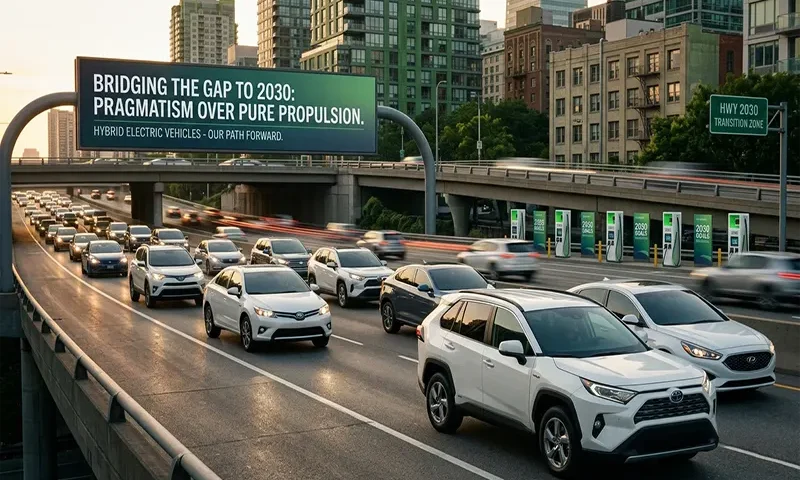
In the early 2020s, the automotive narrative was singular: the future is all-electric, and the internal combustion engine (ICE) is a relic of the past. However, as we move through 2026, a significant re-calibration is underway. Global automakers like Ford, GM, and Mercedes-Benz have pivoted their aggressive “EV-only” timelines toward a more diversified fleet. In this new landscape, the Hybrid Electric Vehicle (HEV) and the Plug-in Hybrid (PHEV) have emerged not as a compromise, but as a strategic “bridge” to 2030.
This shift represents a transition from idealistic ambition to industrial pragmatism. While the destination remains zero-emission transport, the path is being paved with hybrid technology that meets the consumer where they are today.
1. Infrastructure vs. Ambition: Solving the “Charging Anxiety”
The primary hurdle for Battery Electric Vehicles (BEVs) remains the uneven rollout of charging infrastructure. While urban centers boast dense networks of fast chargers, rural and suburban regions still face a fragmented landscape. In 2026, “Range Anxiety” has evolved into “Charging Anxiety”—the fear of arriving at a station only to find chargers broken, occupied, or incompatible.
Hybrids solve this equation by decoupling environmental progress from infrastructure dependence.
- HEVs require zero charging, operating as highly efficient gasoline cars.
- PHEVs offer the ability to charge for daily commutes while maintaining a gasoline fallback for long-haul trips.
By utilizing the existing global network of over 145,000 gas stations while significantly reducing tailpipe emissions, hybrids provide immediate decarbonization without requiring a total overhaul of the power grid or consumer habits.
2. The Economic Reality: Affordability in a High-Rate Environment
As we navigate 2026, the cost of living and interest rates remain key drivers in consumer behavior. The average price of a long-range BEV still carries a premium over its hybrid counterpart, often due to the high cost of large-capacity lithium-ion batteries.
Furthermore, as federal and state subsidies for BEVs have tapered or become more restrictive regarding battery sourcing, the “Total Cost of Ownership” (TCO) advantage has shifted. For many middle-class families, a $30,000 hybrid is a more viable financial move than a $50,000 electric SUV. This affordability ensures that the transition to greener transport is inclusive, rather than a luxury reserved for high-income households.
3. The Technological Evolution of the 2026 PHEV
The Plug-in Hybrids of 2026 are a far cry from the limited models of five years ago. Modern PHEVs, such as the Mercedes-Benz GLC 350e and the redesigned Toyota RAV4 PHEV, are now achieving electric-only ranges of 50 to 80 miles.
Since the average daily commute is under 40 miles, these vehicles function effectively as EVs for 90% of their life cycle. Combined with new DC fast-charging capabilities—which allow a PHEV battery to reach 80% in just 20 minutes—the modern hybrid offers the “best of both worlds.” It provides the silent, torque-heavy experience of an EV without the logistical penalty of a 45-minute charging stop during a family road trip.
4. The Manufacturer Perspective: Funding the Future
From the manufacturer’s side, doubling down on hybrids is a survival strategy. Legacy automakers have realized that the massive R&D costs of solid-state batteries and autonomous platforms must be funded by profitable, high-volume sales today.
Toyota’s “multi-pathway” strategy, once criticized as being behind the curve, has become the industry blueprint in 2026. By selling millions of hybrids, companies generate the capital needed to build the 2030 all-electric infrastructure. For companies like Ford, where the Hybrid F-150 now accounts for 30% of sales, the hybrid is the engine of corporate resilience.
5. Environmental Impact: The “1:6:90” Argument
The most compelling argument for the hybrid bridge is the “Better Now” philosophy, often summarized by the 1:6:90 Rule. This rule states that the amount of raw battery materials required for a single long-range BEV (like a Tesla Model S) could instead be used to create 6 PHEVs or 90 standard HEVs.
| Vehicle Type | Battery Raw Material Use | Total Fleet Emission Reduction |
| 1 BEV | 100% | High (for 1 car) |
| 6 PHEVs | 100% | Higher (across 6 cars) |
| 90 HEVs | 100% | Highest (across 90 cars) |
Putting 90 hybrids on the road today—replacing 90 aging, inefficient internal combustion vehicles—results in a much larger immediate reduction in global CO2 than putting a single EV on the road and leaving 89 gasoline cars in service.
A Paved Road to 2030
The rise of hybrids in 2026 is not a sign of failure for the electric movement; it is a sign of its maturity. The “All-Electric Future” hasn’t been canceled; it is simply being approached with a greater understanding of the economic, social, and logistical hurdles involved. By acting as a pragmatic bridge, hybrids are ensuring that the road to 2030 is sustainable, affordable, and—most importantly—already under construction.

