
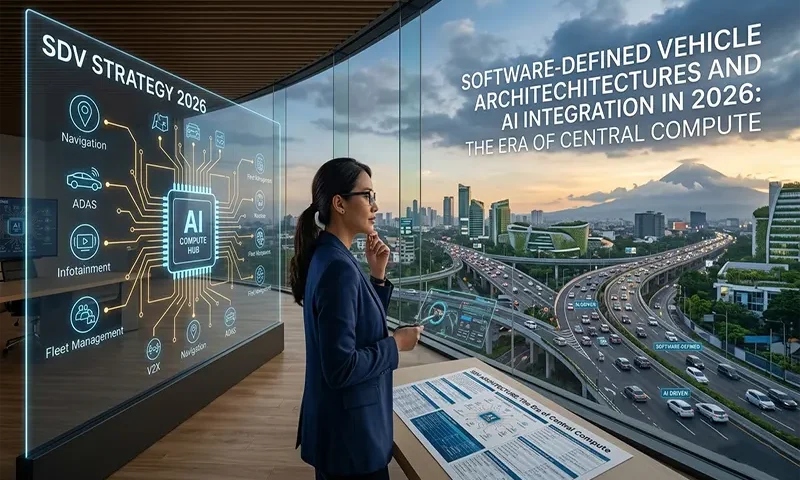
The Consumer Electronics Show (CES 2026) marked a definitive turning point for the automotive industry. The “Software-Defined Vehicle” (SDV) has moved out of the experimental lab and into full-scale industrialization. In 2026, the car is no longer viewed as a mechanical assembly with added computers, but as a high-performance, AI-driven mobile data center.
This shift is underpinned by a radical restructuring of electronic architectures and the deep integration of Agentic AI, fundamentally changing how vehicles are built, operated, and experienced.
1. The Shift to Centralized and Zonal Compute
For decades, vehicles relied on a “distributed” model with over 100 independent Electronic Control Units (ECUs) managing specific functions like windows, brakes, or infotainment. In 2026, this model has officially collapsed under its own complexity.
The Death of the Standalone ECU
Leading OEMs, including BMW with its Neue Klasse and Mercedes-Benz with MB.OS, have transitioned to Centralized and Zonal Architectures. This model utilizes a powerful central “brain”—a super-integration processor like the NXP S32N7 series—to handle high-level logic.
- Zonal Gateways: Instead of miles of wiring, zonal controllers are placed in physical regions of the car (e.g., front-left, rear-right) to manage local sensors and actuators.
- Impact: This transition has reduced wiring harness weight by up to 30%, a critical factor in extending the range of 2026 electric vehicle models.
- Virtualization: By using ASIL-grade hypervisors, safety-critical steering logic can run on the same silicon as the infotainment system, isolated in secure virtual partitions.
2. Agentic AI & The Predictive Cockpit
The “Voice Assistant” of 2024 has evolved into the Agentic AI Co-pilot of 2026. Unlike previous systems that required specific triggers, Agentic AI possesses reasoning capabilities and “agency” to act on behalf of the driver.
From Reactive to Proactive
Integrated into platforms like the Bosch AI Extension, these agents interpret context through Vision-Language Models (VLM).
- Predictive Maintenance: If the onboard diagnostics detect a slight vibration pattern in the electric drivetrain, the AI doesn’t just display a warning light. It proactively checks the driver’s calendar, finds a gap on Wednesday, and pre-orders the necessary part at the local service center.
- Adaptive Safety: Agentic layers now refine ADAS decision logic in ambiguous conditions—such as heavy rain or confusing construction zones—by reasoning through “what-if” scenarios in real-time.
- Productivity: Collaborative efforts between Microsoft and Bosch have turned 2026 cockpits into mobile offices. The AI can manage a Teams call, summarize documents, and simultaneously adjust the Adaptive Cruise Control to prioritize safety based on the driver’s cognitive load.
3. AI-Led Engineering: The Digital Twin Revolution
In 2026, AI is not just in the car; it is the lead architect of the car. The development cycle for new models has been slashed from 60 months down to 24–36 months through AI-driven virtualization.
- Virtual Validation: OEMs now use Machine Learning to automate Software-in-the-Loop (SIL) and Hardware-in-the-Loop (HIL) testing. AI agents generate millions of edge-case scenarios—such as a pedestrian appearing from behind a bus in a blizzard—that human testers might miss.
- Digital Twins: Every 2026 SDV has a digital counterpart in the cloud. This allows engineers to simulate the long-term impact of a new battery-management software update on 50,000 vehicles before a single line of code is sent over-the-air (OTA).
4. The Regulatory & Economic Landscape: The OBBBA Impact
The financial framework for these advancements in the U.S. has been significantly altered by the One Big Beautiful Bill Act (OBBBA), signed into law in mid-2025.
- Software Investment Incentives: While the OBBBA began phasing out some Biden-era clean energy credits, it introduced permanent extensions for Section 179 expensing. This allows companies to immediately write off investments in the digital infrastructure required for SDVs, such as cloud-compute clusters and advanced semiconductor R&D.
- Cybersecurity Mandates: With vehicles now being “connected nodes,” 2026 models are strictly governed by UN R155 and ISO/SAE 21434. The OBBBA-driven focus on domestic “Clean Manufacturing” has pushed U.S. OEMs to bake cybersecurity into the silicon level to protect against large-scale fleet hacks.
5. 2026 SDV Technology Snapshot
| Architecture Component | Key Benefit | Leading 2026 Examples |
| Central Compute (SoC) | Reduced complexity; 20% lower electronics cost. | NXP S32N7, NVIDIA Drive Orin |
| Zonal Gateways | Drastic weight reduction; modular assembly. | Tesla Model 4, Nissan Leaf (2026) |
| Middleware (Alloy Kore) | Hardware-software decoupling; faster OTA. | QNX & Vector Collaboration |
| Agentic AI Layer | Predictive services; context-aware safety. | MB.OS, BMW Neue Klasse |
6. Monetization & The ROI Challenge
Despite the technical leaps, 2026 remains a year of financial reckoning for the “Feature-on-Demand” (FoD) model. While consumers have embraced subscriptions for Level 3 Autonomous Driving on highways, there is significant resistance to paying monthly fees for hardware-baked features like heated seats.
The successful OEMs of 2026 have pivoted toward “Vehicle-as-a-Service” (VaaS). Instead of one-time sales, they offer contracts tied directly to telematics, where the monthly rate is optimized by AI based on actual usage and the vehicle’s “health score,” maintained by continuous OTA updates.
The 2026 automotive industry is no longer defined by horsepower or torque, but by compute density and AI reasoning. The integration of Software-Defined Architectures has turned the vehicle into a living product that improves every week. As Agentic AI takes the wheel—both in the engineering lab and on the highway—the boundary between the digital and physical worlds of mobility has finally disappeared.

