
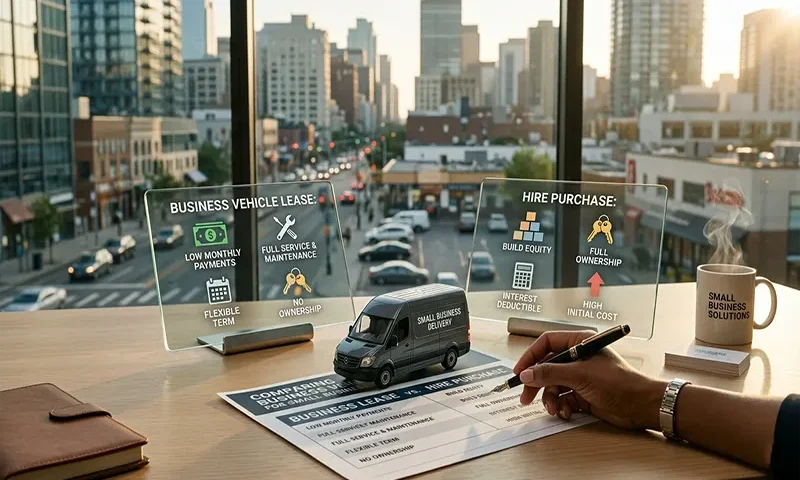
In the current 2026 economic climate, small business owners are facing a complex automotive market. With interest rates stabilizing at higher-than-historical averages and the rapid evolution of electric vehicle (EV) battery technology, the decision between “usership” and “ownership” has never been more consequential.
The passage of the One Big Beautiful Bill Act (OBBBA) in the U.S. and the recent HMRC capital allowance adjustments in the UK have redrawn the tax boundaries for vehicle acquisition. Deciding between a Business Contract Hire (Lease) and a Hire Purchase (HP) agreement is no longer just about monthly payments; it’s about strategic tax positioning and risk mitigation.
1. The Case for Leasing: The “Cash Flow” King
Leasing, or Business Contract Hire, is a “usership” model where you pay for the vehicle’s depreciation over a fixed term—usually 24 to 48 months—and return it at the end.
Why Leasing Wins in 2026
- The “Tech Hedge”: With 2030 zero-emission mandates approaching, EV technology is advancing rapidly. Leasing protects your business from the risk of owning an obsolete vehicle with a degraded battery or outdated software-defined architecture.
- Preservation of Capital: Leasing typically requires a lower initial outlay (often equivalent to 3 or 6 monthly payments) compared to the substantial deposit required for HP.
- Predictable Budgeting: Most 2026 lease contracts include maintenance, road tax (VED), and breakdown cover, providing a single, fixed monthly expense that simplifies accounting.
2026 Tax Treatment (Lease)
Lease rentals are generally treated as an allowable business expense. In the UK, if the vehicle’s CO2 emissions exceed 50g/km, 15% of the lease rental is disallowed for tax purposes. However, for 100% electric vehicles, the full rental is usually deductible. Additionally, businesses can typically reclaim 50% of the VAT on lease payments for cars (to account for private use) or 100% for vans.
2. The Case for Hire Purchase: The “Asset” Strategy
Hire Purchase is a path to ownership. You pay a deposit and fixed monthly installments, and after the final payment (often including an “option to purchase” fee), the vehicle belongs to the business.
Why Hire Purchase Wins in 2026
- Equity Building: At the end of the term, you own a tangible asset. This is particularly valuable for “workhorse” vehicles like cargo vans or heavy trucks that have long lifespans and high utility even after the finance is cleared.
- No Mileage Penalties: Unlike leasing, which carries steep “excess mileage” charges, HP allows you to drive the vehicle as much as your business requires without financial penalty.
- Customization: If your business requires specific racking, branding, or modifications, ownership via HP is often the only viable route.
2026 Tax Treatment (Hire Purchase)
This is where HP often outshines leasing. Under the OBBBA (U.S.), businesses can utilize Section 179 to deduct the full purchase price of qualifying equipment in the first year. For 2026, the Section 179 limit has been adjusted to $2,560,000, and 100% Bonus Depreciation has been restored, allowing for massive immediate tax relief.
In the UK, vehicles bought via HP qualify for Capital Allowances. While cars are subject to stricter rules, new and unused electric cars still qualify for a 100% First-Year Allowance through April 2027, allowing you to write off the entire cost against your profits in year one.
3. The 2026 “Green” Incentives: A Critical Distinction
The choice of vehicle type (ICE vs. EV) heavily influences which finance method is superior.
- For Electric Vehicles: HP is highly attractive due to the 100% first-year write-off available in both the US and UK. However, if you are concerned about the resale value of EVs in three years, the fixed-cost “exit” of a lease may be worth more than the tax deduction.
- For Heavy Vehicles: Under the OBBBA, vehicles over 6,000 lbs GVWR (like heavy pickups and large SUVs) unlock the largest Section 179 deductions. If you are buying a heavy truck, HP is almost always the more tax-efficient route.
4. Operational Constraints & Hidden Costs
Small businesses must look beyond the monthly quote to find the true cost of each model.
| Feature | Business Lease | Hire Purchase |
| Upfront Cost | Low (Initial Rental) | High (Deposit + Full VAT on Vans) |
| Balance Sheet | Off-Balance Sheet (usually) | On-Balance Sheet Asset |
| Resale Risk | None (Risk stays with the bank) | High (You must sell the vehicle) |
| Maintenance | Often included in monthly fee | Business responsibility |
| Flexibility | Rigid (High early exit fees) | Flexible (Can sell/refinance) |
5. Decision Matrix: Which is Right for You?
Choose a Business Lease if:
- You want to upgrade your vehicles every 3 years to stay current with EV tech.
- You need to preserve cash flow for other areas of the business.
- You want “hands-off” fleet management with maintenance included.
- You have a predictable annual mileage.
Choose Hire Purchase if:
- You want to maximize your tax deduction this year via Section 179 or 100% Capital Allowances.
- You plan to keep the vehicle for 5+ years or until it reaches the end of its life.
- The vehicle will undergo heavy wear and tear or requires custom branding.
- You have a high taxable income this year that needs to be offset.
In 2026, the “best” option depends entirely on your business’s tax bracket and technology appetite. While Hire Purchase offers a superior “one-time” tax win through the restored 100% depreciation rules, Leasing provides the operational agility required in a rapidly changing automotive market. Before signing, always request a “Total Cost of Ownership” (TCO) comparison that includes the tax savings specific to your jurisdiction’s 2026 limits.

