
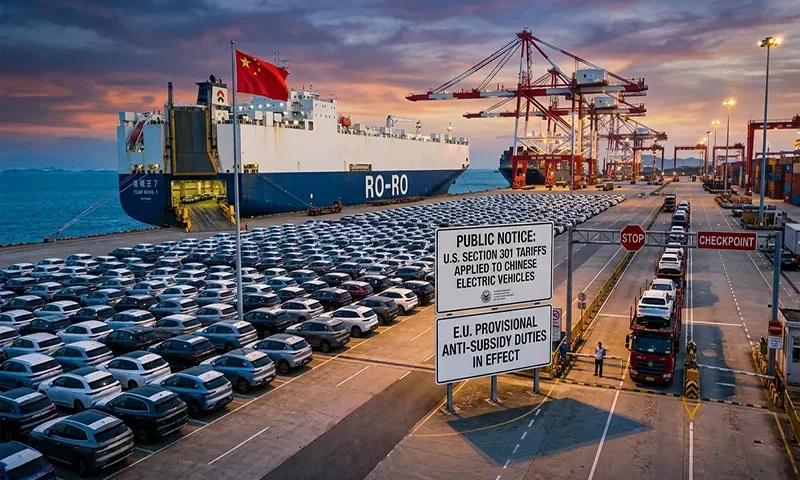
Entering 2026, the global automotive landscape is defined by a new geopolitical “Iron Curtain,” built not of concrete, but of import duties. The widely predicted “tsunami” of cheap Chinese Electric Vehicles (EVs) crashing onto Western shores has been halted, but not by market forces. Instead, a coordinated wall of protectionist tariffs, erected by the United States and the European Union, has forced a massive and historic re-calibration of China’s EV expansion strategy.
The era of direct, high-volume shipping from Shanghai to Los Angeles or Rotterdam is over. In its place, 2026 has given rise to a “Great Re-Routing,” characterized by localized manufacturing hubs within tariff zones, a strategic pivot to the “Global South,” and a complex, contentious exploitation of trade loopholes. The West may have “fortressed” its domestic markets, but it has not stopped the global expansion of Chinese EV dominance.
1. The Tariff Wall: 2026 Status Report
The current state of play in 2026 represents the full implementation of policies drafted over the last two years. The One Big Beautiful Bill Act (OBBBA) in the United States effectively closed the U.S. market to direct Chinese imports by raising tariffs on all Chinese-made EVs to 100%, a move mirroring the Section 301 duties that remain in full effect.
In Europe, the situation is more nuanced but equally restrictive. Following its extensive anti-subsidy investigation, the E.U. has applied definitive duties ranging from 7.8% to 35.3%, stacked on top of the existing 10% auto tariff. These variable rates depend on the manufacturer’s level of cooperation with the E.U. probe and the level of state subsidies received. The collective result is clear: a Chinese EV that costs $20,000 to produce cannot compete against a subsidized European or American counterpart when priced at $40,000+ due to tariffs.
2. The E.U. Paradox: Tariffs as a Catalyst for Localization
The primary consequence of the E.U.’s tariff strategy has been an outcome it sought to avoid: the rapid “Sinification” of European automotive manufacturing. Rather than retreating, major Chinese players have aggressively “localized” their supply chains to bypass the duties.
2026 is the year this localization hit critical mass.
- BYD’s landmark assembly plant in Hungary has entered full mass production, churning out “European-made” vehicles that bypass all import duties.
- Stellantis and Leapmotor have solidified their partnership, utilizing Stellantis’s existing footprint in Spain to build Leapmotor-branded EVs for the continental market.
- The groundbreaking “Price Undertaking” model, first established in early 2026 (the “VW-Anhui Deal”), allows Chinese firms to bypass the maximum 35.3% tariff if they adhere to strict minimum import prices, effectively turning a trade war into a market-sharing agreement.
Ironically, E.U. protectionism has accelerated the building of a robust Chinese manufacturing presence inside its own borders, creating European jobs but also solidifying Chinese technological influence.
3. The U.S. Exclusion and the “Canada Loophole”
While Europe is integrating Chinese manufacturing, the United States, under the strict protectionism of the OBBBA, remains a “fortress.” Direct Chinese EV imports to the U.S. have effectively ceased, leading to a visible retreat of Chinese auto brands from American soil.
However, the North American “moat” has developed a leak. In January 2026, Canada signed a landmark trade deal with Beijing, creating a special quota that allows 49,000 Chinese EVs into Canada at a preferential 6.1% tariff. This agreement, a deliberate challenge to the USMCA (U.S.-Mexico-Canada Agreement), has turned Canada into a potential back door for Chinese vehicles.
While the U.S. remains sealed off, this move has caused deep political friction within North America, as Washington fears that vehicles assembled with a high percentage of Chinese parts in Canada could find their way across the southern border, bypassing OBBBA rules of origin.
4. The Global Pivot to the “Rest of the World”
Perhaps the most dramatic consequence of Western protectionism is the explosion of Chinese EV dominance across the “Global South” and the Middle East. With the $1.1 trillion U.S. market largely closed and the E.U. market increasingly complex, Chinese manufacturers have re-deployed their capital and production to regions where they are welcomed.
This pivot has been a staggering success.
- In Brazil, Chinese brands (led by BYD and GWM) now account for nearly 50% of all EV sales. In 2026, six new Chinese assembly plants opened in South America, creating a “localized for South America” ecosystem.
- In Thailand and Southeast Asia, the market share of Japanese ICE vehicles continues to collapse, replaced by aggressively priced Chinese EVs that are fast-tracking national electrification goals.
- The 2026 oil shock (stemming from the continued Middle East conflict) has, counterintuitively, sped up EV adoption in the developing world, where gas prices have become unsustainable. Chinese brands have reported 84% growth in “Rest of World” exports this year, offsetting their losses in North America.
| Region | Primary 2026 EV Tariff | Market Impact | Strategic Response |
| United States | 100% (OBBBA/Sec 301) | Market Exclusion | Retreat; Pivot to non-U.S. global markets |
| European Union | 7.8% – 35.3% (Definitive Duties) | Complexity & Cost Increase | Localization (build factories in Hungary, Spain) |
| Canada | 6.1% (Quota Deal – Jan 2026) | Selective Entry (49k units) | Exploit as North American beachhead |
| Global South (e.g., Brazil) | Low / No Tariff | Rapid Market Dominance (+50% share) | Direct Sales & New Assembly Plants |
5. The Vertical Integration Moat
Ultimately, the central conflict of the 2026 EV landscape is one that tariffs cannot solve. Tariffs are designed to offset a “cost advantage” built on subsidies, but they cannot neutralize the cost advantage of vertical integration.
Chinese manufacturers (particularly BYD, which owns its entire battery supply chain from lithium mining to cell production) maintain a 25% to 30% cost advantage over their Western counterparts. Even with a 100% tariff in the U.S., a Chinese EV remains a fundamentally cheaper product to make. Furthermore, as “Software-Defined Vehicles” become the new standard, Western tariffs provide no protection against the superior infotainment, user experience, and OTA (Over-the-Air) capabilities of Chinese platforms.
The Great Bifurcation
The U.S. and E.U. tariffs have successfully achieved their narrowest objective: they have prevented Chinese automakers from decimating their domestic auto industries. The West has “fortressed” itself, creating a bifurcated global market.
By 2030, the global automotive industry will likely be split into two distinct ecosystems. One ecosystem (the “Fortress West”) will be comprised of expensive, domestically produced vehicles from legacy players, insulated by trade barriers. The second ecosystem (the “Rest of the World”) will be a vibrant, low-cost, technology-driven market dominated by Chinese brands and their localized joint ventures. The trade war of 2026 has not stopped China from winning the global race for EV dominance; it has simply forced them to choose a different track.

