
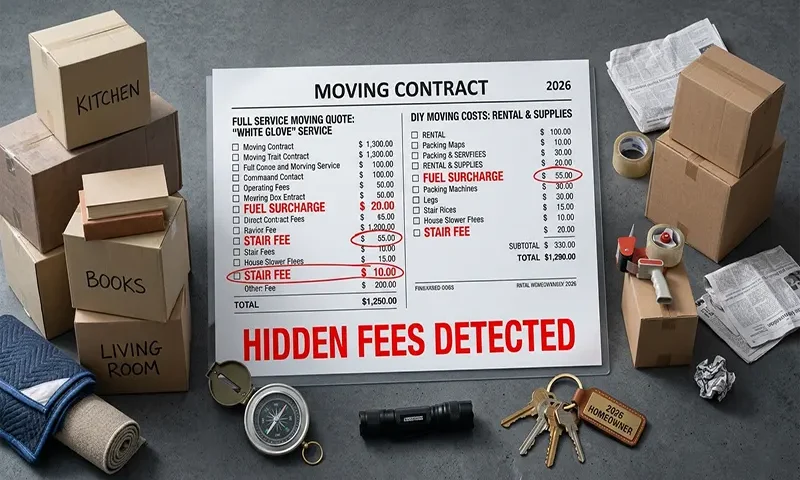
In 2026, the moving industry is witnessing a “Great Divergence” in pricing. While DIY truck rentals still market themselves with low daily rates, the all-in cost of a self-move has crept closer to professional rates due to surging fuel surcharges and mileage fees. Conversely, full-service movers have leaned into high-tech inventory tools to offer more competitive “not-to-exceed” quotes.
Choosing between the two—or the increasingly popular “Hybrid” model—is no longer a simple question of effort, but a strategic financial decision.
1. The Introduction: The “Illusion of Cheap”
The most common mistake homeowners make in 2026 is comparing a $49/day truck rental to a $2,500 moving quote. The “Base Rate Trap” often masks the reality that DIY moves frequently end up costing 50% to 70% of a professional move once all variables are tallied.
As of April 2026, the national average for a 3-bedroom home move (local) stands at:
- Full Service: $1,350 – $3,300
- DIY (Truck Rental): $850 – $1,250 (All-in)
- Hybrid (Container/PODS): $950 – $1,500
2. The Anatomy of a Full-Service Quote
A full-service quote is an all-inclusive “peace of mind” package. In 2026, professional movers provide more than just muscle; they provide insurance and logistics.
- Labor & Expertise: You are paying for a crew (typically 3–4 people) billed at $65 to $250 per hour. This includes professional packing, furniture disassembly, and the “Tetris-like” skill required to maximize truck space.
- The Safety Premium: Professional movers are legally required to provide Released Value Protection (covering $0.60 per pound). However, in 2026, many homeowners opt for Full Value Protection, which costs about 1% to 5% of the shipment’s total value but ensures a $2,000 TV is actually replaced if broken.
- The Equipment: Heavy-duty moving blankets, floor runners (to protect hardwoods), and specialized dollies are included.
3. The Hidden Math of the DIY Move
The DIY route is where “nickel and diming” becomes a major factor. The $19.95 or $49.95 base rate is merely the entry fee.
- The Mileage Factor: Most local rentals in 2026 charge between $0.89 and $0.99 per mile. For a 50-mile round trip, that is an extra $50 before you’ve even bought gas.
- Fuel & Environmental Fees: Large 26-foot moving trucks typically get only 8–12 MPG. In a 2026 economy with fluctuating fuel prices, a 100-mile move can easily cost $60+ in gas alone, plus a standard $5–$10 environmental fee.
- Invisible Consumables: To move a 3-bedroom house safely, you will likely spend $200 to $500 on boxes, bubble wrap, and tape. If you don’t own moving blankets, renting a dozen from the truck company adds another $20–$40.
- The “Social Tax”: Unless you are moving entirely alone, you’ll spend $100 to $200 on pizza, drinks, and “thank you” gifts for the friends helping you—assuming they don’t injure themselves, which carries its own set of complications.
4. The 2026 Hybrid Alternative (Moving Containers)
The middle ground is currently the fastest-growing segment of the market. Services like PODS or U-Pack provide the container; you provide the labor.
- How it Works: A container is dropped at your door. You pack it over several days. They pick it up and drive it to the destination.
- Cost Advantage: For a 1,000-mile move, a container typically costs $2,800 – $4,800, roughly 40% less than a full-service interstate move ($5,000 – $11,000).
- The 2026 Benefit: This model eliminates the stress of driving a massive, unfamiliar vehicle through traffic or mountain passes, which is a major “hidden cost” of DIY moves.
5. 2026 Cost Comparison Table: 3-Bedroom Home
| Move Distance | DIY (Truck Rental) | Hybrid (PODS/Containers) | Full-Service Movers |
| Local (< 50 miles) | $100 – $750* | $800 – $1,400 | $1,350 – $3,300 |
| Mid-Range (500 miles) | $700 – $1,200 | $2,400 – $3,800 | $3,150 – $5,800 |
| Interstate (1,000 miles) | $1,000 – $1,850 | $2,900 – $4,800 | $3,850 – $6,750 |
| Cross-Country (2,500+ mi) | $1,500 – $2,800 | $4,100 – $7,400 | $6,000 – $11,000+ |
*Note: DIY Local prices exclude labor. If you hire “labor-only” help, add $400–$800.
6. Decision Triggers: When to Pay, When to Play
Choose DIY if:
- You are moving locally (under 20 miles).
- You have a “minimalist” 1–2 bedroom setup.
- You have access to a large, reliable “friend-crew” and ground-floor access.
Choose Full-Service if:
- You have high-value items (pianos, artwork, or 2026-era electronics).
- You are moving during a work week and cannot afford the 24–48 hours of labor DIY requires.
- You have a complex move (multi-story apartments or narrow city streets).
The verdict for 2026 is clear: DIY is only “cheaper” if you value your time at zero. For small, local moves, the savings are real. However, for a 3-bedroom home, once you factor in the $400 in supplies, the $150 in fuel/mileage, and the two full days of grueling labor, the $1,000 to $1,500 difference to hire a full-service crew often becomes the best investment you can make during a relocation.
Pro Tip: Always get a Binding Not-to-Exceed quote. In 2026, most reputable movers will provide this after a virtual 3D home scan, protecting you from “surprise” weight charges on moving day.

