
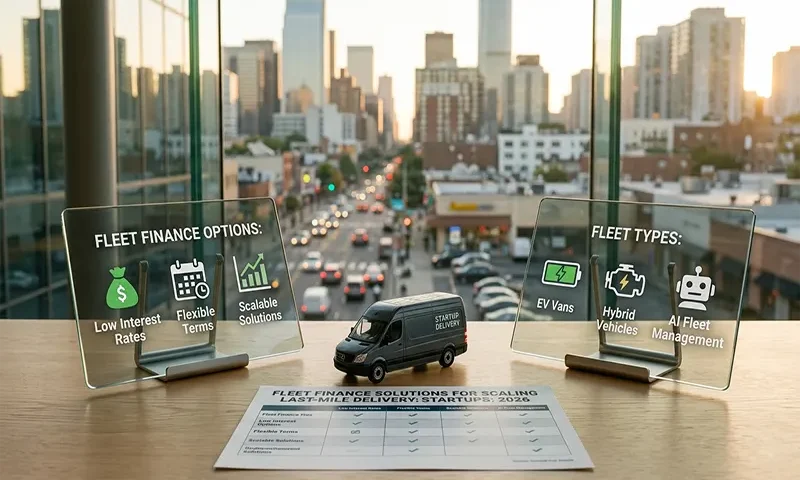
In 2026, the last-mile delivery sector has moved beyond the “growth at all costs” phase into an era of “efficient electrification.” For startups, scaling a fleet is no longer just a logistical challenge; it is a complex financial maneuver. With the high-interest-rate environment of the mid-2020s stabilizing and the One Big Beautiful Bill Act (OBBBA) redefining tax incentives, founders must balance capital expenditure (CapEx) with operational agility.
Success in 2026 requires a “Hybrid Elastic Capacity” model—owning a core fleet of high-utilization assets while leveraging flexible financing to handle seasonal surges.
1. Navigating the OBBBA Tax Landscape
The One Big Beautiful Bill Act (OBBBA) remains the most significant driver of fleet acquisition strategy this year. As we move through the 2026 fiscal year, understanding the specific mechanics of tax depreciation is vital for cash flow management.
- Modified Bonus Depreciation: Under current 2026 rules, Bonus Depreciation has transitioned to 40%. While lower than the 100% rates of the early 2020s, it still allows for significant front-loaded tax relief for startups with high taxable income.
- Section 179 Expensing: For 2026, the Section 179 limit has been adjusted to $2,560,000. This allows startups to deduct the full purchase price of qualifying delivery vans and heavy trucks (over 6,000 lbs GVWR) up to the limit, provided the total equipment purchase does not exceed $3.1 million.
- Commercial Clean Vehicle Credit (IRC Sec. 45W): For startups transitioning to EVs, this credit provides up to $7,500 for light-duty vehicles and up to $40,000 for heavy-duty trucks. A critical deadline looms on June 30, 2026, for several infrastructure-related “stacking” credits, making H1 2026 the optimal window for fleet deployment.
2. Asset-Backed Finance (ABF) vs. Traditional Leasing
In 2026, venture capital is increasingly wary of funding heavy hardware. This has made Asset-Backed Finance (ABF) the primary vehicle for scaling.
Operating Leases (FMV)
Many startups prefer the Fair Market Value (FMV) Lease. This keeps the vehicles “off-balance sheet” (depending on specific GAAP/IFRS 16 applications), which can help maintain a cleaner valuation for future funding rounds. It also provides an easy “exit” at the end of the 36-month term, which is crucial given the rapid evolution of autonomous-ready delivery sensors.
Capital Leases & Hire Purchase
For startups with a long-term view, Capital Leases allow the business to claim both the interest expense and the depreciation (including OBBBA benefits). This is ideal for “workhorse” fleets where the startup intends to own the asset for its full 5-to-7-year lifecycle.
The Rise of “Flex-Leasing”
New for 2026, major fleet providers are offering “Elastic Contracts.” These allow a startup to scale their fleet up by 20% during peak months (November/December) and return the surplus in January without the traditional early-termination penalties.
3. Financing the Electric Transition
The Total Cost of Ownership (TCO) for electric delivery vans has reached a “tipping point” in 2026, thanks to battery prices dropping nearly 50% since 2023. However, the high upfront cost remains a hurdle.
- Charging-as-a-Service (CaaS): Startups are no longer financing chargers through their vehicle loans. Instead, CaaS providers offer “subscription-based” infrastructure. The chargers, grid upgrades, and maintenance are bundled into a monthly OpEx fee, allowing the startup to preserve its credit lines for the vehicles themselves.
- Green Bonds and ESG Loans: Startups that maintain rigorous ESG (Environmental, Social, and Governance) reporting can now access “Sustainability-Linked Loans.” These offer interest rates that are 50 to 100 basis points lower than market rates, provided the startup hits specific carbon-reduction milestones.
4. The Rise of Embedded Fleet Fintech
The “dumb” vehicle loan is dead. In 2026, Telematics-Integrated Financing has become the industry standard.
Lenders now require integration with platforms like Geotab or Samsara. By sharing real-time data on engine health, driver safety scores, and route efficiency, startups can unlock “Performance-Based Interest.” If your fleet’s accident rate stays below a certain threshold, your interest rate automatically drops. This real-time risk assessment allows lenders to offer higher leverage to startups that can prove they are low-risk operators.
5. 2026 Fleet Finance Snapshot Table
| Financing Instrument | Best For | Impact on Balance Sheet | Key Advantage in 2026 |
| Asset-Based Lending (ABL) | Series A/B Startups | On-Balance Sheet | High leverage based on total asset value. |
| Operating Lease (FMV) | High-Growth / High-Tech | Off-Balance Sheet | Protects against EV battery tech obsolescence. |
| Venture Debt | Bridge to Next Round | Mixed | Preserves equity while funding specific expansion. |
| Flex-Lease / Pay-per-Mile | Seasonal / Gig-Hybrid | Off-Balance Sheet | Maximum agility; pay only for actual utilization. |
The Visibility Game
In 2026, scaling a last-mile delivery startup is as much a financial challenge as a physical one. Founders must move away from simple bank loans and toward a sophisticated mix of ABF, OBBBA tax positioning, and CaaS infrastructure models.
The most successful startups this year will be those that treat their fleet data as a financial asset. By integrating telematics with their financing partners, they won’t just move packages faster—they will unlock the low-cost capital required to dominate the final mile.
Final Strategic Tip: Before the June 2026 deadline, audit your depot locations for Section 30C eligibility. Financing your charging hubs in “low-income or rural” census tracts can unlock an additional 30% tax credit that significantly offsets the cost of your 2026 expansion.

