
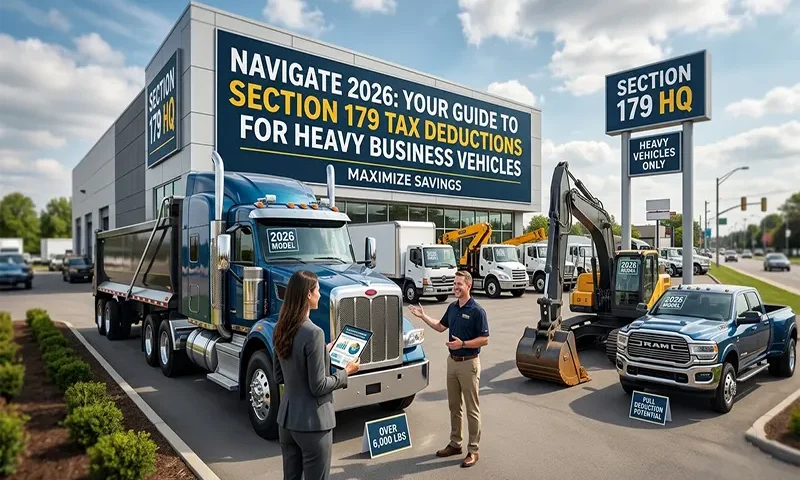
For business owners, the tax code is rarely described as “generous,” but Section 179 is the notable exception. In 2026, the intersection of updated inflation-adjusted limits and the recent restoration of 100% Bonus Depreciation under the One Big Beautiful Bill Act (OBBBA) has created a goldmine for those looking to upgrade their business fleet.
If you are considering purchasing a heavy SUV, truck, or van for your business this year, understanding the “6,000-pound rule” could result in writing off the entire purchase price in a single tax year.
1. The Magic Number: The 6,000-Pound GVWR Rule
The IRS distinguishes between “light” passenger vehicles and “heavy” business vehicles based on their Gross Vehicle Weight Rating (GVWR). To unlock the most aggressive tax deductions, a vehicle must have a GVWR of more than 6,000 pounds.
GVWR vs. Curb Weight
It is a common mistake to look at a vehicle’s “curb weight” (what it weighs empty). The IRS cares about the GVWR, which is the maximum weight the vehicle is rated to carry, including passengers, cargo, and fuel. You can typically find this number on the manufacturer’s label inside the driver’s side doorjamb.
Popular 2026 models that typically qualify as “Heavy”:
- Pickups: Ford F-150, RAM 1500, Chevrolet Silverado, Toyota Tundra, Tesla Cybertruck.
- SUVs: BMW X5/X7, Chevrolet Tahoe/Suburban, Land Rover Defender, Rivian R1S, Lexus GX 550.
- Vans: Mercedes-Benz Sprinter, Ford Transit (250/350), RAM ProMaster.
2. 2026 Deduction Limits and the “SUV Cap”
While Section 179 is powerful, the IRS applies different ceilings depending on the type of heavy vehicle you buy.
The SUV Limitation
Even if an SUV exceeds 6,000 lbs GVWR, it is subject to a specific Section 179 cap if it is built on a passenger chassis. For 2026, the Section 179 SUV limit is $31,300.
Exempt Vehicles (No Cap)
Vehicles that are not considered “passenger” SUVs are eligible for the full Section 179 deduction up to the 2026 maximum of $2,560,000. These include:
- Pickups with a cargo bed at least six feet in interior length.
- Vans that seat only the driver and a co-pilot (no rear seating).
- Heavy Equipment (forklifts, bucket trucks, etc.) over 14,000 lbs.
| Vehicle Category | GVWR | 2026 Section 179 Limit |
| Light Vehicle | Under 6,000 lbs | ~$20,400 (Total) |
| Heavy SUV | 6,001 – 14,000 lbs | $31,300 |
| Work Truck/Cargo Van | 6,001 – 14,000 lbs | $2,560,000 |
3. The 2026 Super-Deduction: Combining 179 with Bonus Depreciation
The biggest news for 2026 is the return of 100% Bonus Depreciation. In previous years, this percentage was scheduled to phase out, but current legislation has restored it to full strength.
This allows for a “stacked” deduction strategy. You apply Section 179 first, and then apply 100% Bonus Depreciation to any remaining balance.
Example: Buying a $80,000 Heavy SUV (e.g., a BMW X7)
- Section 179: You take the maximum SUV deduction of $31,300.
- Remaining Basis: $80,000 – $31,300 = $48,700.
- Bonus Depreciation: You apply the 100% bonus to the remaining $48,700.
- Total First-Year Deduction: $80,000.
Because of this “stacking” rule, the $31,300 SUV cap effectively becomes irrelevant for most businesses in 2026, as the Bonus Depreciation covers the rest.
4. Crucial Qualification “Gotchas”
To claim these massive write-offs, you must adhere to strict IRS operational rules.
The 50% Business Use Rule
To qualify for Section 179, the vehicle must be used for business more than 50% of the time. If you use the vehicle 70% for business and 30% for personal use, you can only deduct 70% of the cost. If your business use drops to 50% or less in any future year, the IRS may “recapture” the tax savings, forcing you to pay them back.
The “Placed in Service” Deadline
It isn’t enough to just buy the vehicle; it must be placed in service by December 31, 2026. This means you must have the keys and be using it for business activity before the clock strikes midnight on New Year’s Eve.
The Phase-Out Threshold
Section 179 is intended for small and medium businesses. If your total equipment purchases for 2026 exceed $4,090,000, the deduction begins to phase out dollar-for-dollar.
5. Financing and Cash Flow Strategy
One of the most attractive aspects of Section 179 is that you do not have to pay cash for the vehicle to take the full deduction.
If you finance a $100,000 heavy truck with a $0 down payment, you can still deduct the full $100,000 from your 2026 taxable income. For a business in a 35% tax bracket, this results in $35,000 in actual tax savings—often far exceeding the total of your first year’s loan payments. This makes Section 179 a powerful tool for preserving cash flow.
The 2026 tax year offers a rare “perfect storm” for business vehicle investment. With the Section 179 limit at $2,560,000 and Bonus Depreciation back at 100%, the government is effectively subsidizing the modernization of your business fleet.

