
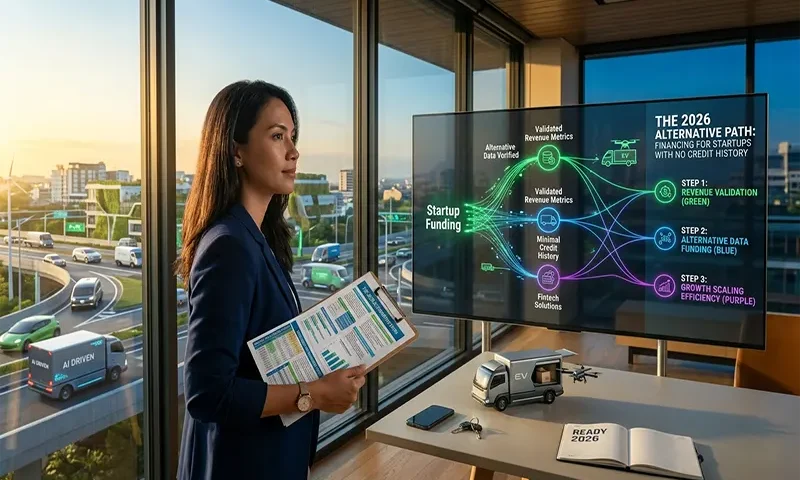
Launching a fleet-based startup in 2026 without a corporate credit history requires a shift from traditional banking to the “Alternative Lending” ecosystem. While legacy banks often demand two years of audited financials and a seasoned credit profile, modern fintechs and Asset-Backed Lenders (ABL) are increasingly using real-time data to underwrite the potential of a business rather than its past.
This guide explores how early-stage entrepreneurs can bypass the “no credit” hurdle by leveraging Open Banking, Collateral-Based Lending, and the evolving vehicle subscription market.
1. The “Chicken and Egg” Logistics Dilemma
The central challenge for any new logistics or service-based startup is the “Chicken and Egg” dilemma: you need a fleet to generate revenue, but traditional lenders require revenue to prove you can afford the fleet.
In 2026, the rise of Cash-Flow Underwriting has fundamentally changed this dynamic. Startups are no longer judged solely on a static FICO score. Instead, lenders are looking for “Credit Velocity”—the real-time movement of money through your business accounts. By providing digital transparency, “no credit” is now a hurdle rather than a dead end.
2. The Personal Guarantee (PG): The 2026 Safety Net
For most founders in their first year, the Personal Guarantee (PG) remains the primary bridge to corporate credit. This involves using your personal credit score as the security for the business loan.
- The Benefit: It allows a brand-new entity (with zero credit history) to access the same interest rates as an established business, provided the founder has a strong personal FICO (typically 680+).
- The 2026 Risk: In the current high-interest environment, a PG means your personal assets (home, savings) are directly at risk if the startup fails.
- The “Graduation” Path: Many 2026 fintech lenders offer “Step-Down PGs,” where the personal guarantee is automatically removed once the business maintains 12 months of consistent revenue.
3. Asset-Backed & Revenue-Based Financing
If you want to keep your personal credit separate, you must look toward financing models that prioritize the value of the asset or the future revenue over the entity’s history.
I. Asset-Backed Lending (ABL)
In an ABL scenario, the vehicle itself acts as the primary security. Since the lender can repossess a high-value asset (like a delivery van or a software-defined EV), they are more willing to overlook a lack of credit history.
- The Trade-off: “No-credit” ABL deals typically require a 20% to 30% down payment.
- The 2026 Advantage: With the One Big Beautiful Bill Act (OBBBA) allowing for 100% Bonus Depreciation, that large down payment can often be recovered via tax savings in the first fiscal year.
II. Revenue-Based Financing (RBF)
RBF is the fastest-growing sector for 2026 startups. Instead of a fixed monthly payment, you repay the loan as a percentage of your daily sales.
- How it works: You link your business bank account via Plaid or Yodlee. The AI lender analyzes your “sales velocity.”
- Flexible Repayment: If you have a slow month, your payment automatically drops. If revenue spikes, you pay the loan off faster.
4. The Hybrid Model: Subscriptions and Rent-to-Own
The vehicle subscription market has exploded in 2026, reaching a $13 billion valuation. For startups, this offers a “frictionless” entry point.
- Business Subscriptions: Platforms like Hertz MyCar for Business or OEM-direct programs (Volvo, Porsche, Hyundai) offer all-inclusive monthly fees that cover insurance, maintenance, and the vehicle. Because these are technically “short-term rentals” rather than “debt,” the credit requirements are significantly lower.
- Rent-to-Own (Lease-Purchase): This model allows you to lease a vehicle with the option to purchase it after 12 or 24 months. Crucially, in 2026, most of these providers report your on-time payments to Dun & Bradstreet, helping you build a corporate credit file while you work.
5. 2026 Finance Comparison Table
| Option | Credit Requirement | Approval Speed | Typical APR / Cost |
| Traditional Bank | High (2+ yrs history) | 2–4 Weeks | 6.5% – 9% |
| Fintech (RBF/ABL) | Low (Open Banking) | 24–48 Hours | 9% – 15% |
| Subscription Model | Very Low | Instant | All-inclusive monthly fee |
| Captive Finance (OEM) | Moderate (PG usually req.) | 1–3 Days | 7% – 12% |
📈 THE 12-MONTH CREDIT-BUILDING ROADMAP
- Month 1: Incorporate and obtain an EIN. Open a dedicated business bank account.
- Month 2: Apply for a “Net-30” account with a fuel provider (like WEX or Shell) to start reporting trade lines.
- Month 3: Secure your first 1-2 vehicles via a Subscription Model that reports to business bureaus.
- Month 12: Use your 12 months of clean “Cash Flow” data to transition into a traditional Equipment Lease with no Personal Guarantee.
Financing a fleet with no credit history in 2026 is a matter of data transparency. By moving away from legacy banks and embracing Open Banking fintechs and subscription models, startups can get on the road immediately. The goal for any new founder should be to use these higher-cost “alternative” paths as a temporary bridge to build the robust corporate credit profile that will eventually unlock the lowest market rates.

