
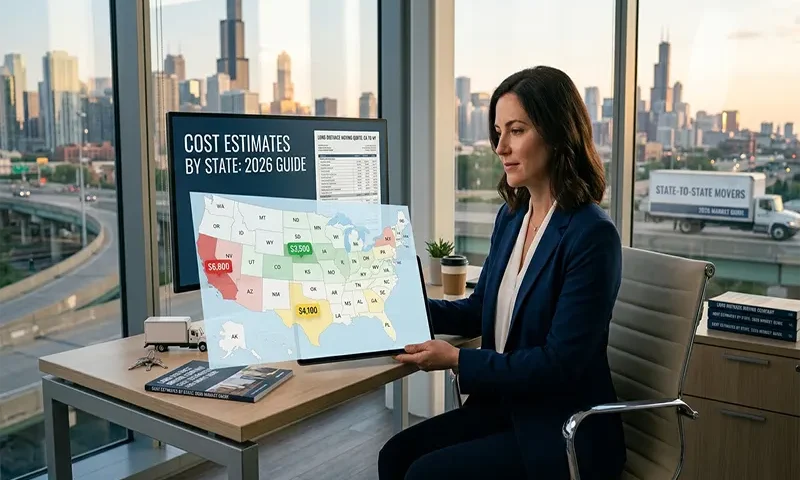
Interstate moving in 2026 is no longer a simple calculation of “miles times weight.” As migration patterns across the United States have shifted, moving costs have become increasingly dictated by geography and market demand. Today, a move from New York to Florida may cost significantly more than a move of the exact same distance in the opposite direction.
On average, a long-distance move for a two-to-three-bedroom home in 2026 ranges between $3,500 and $8,500. However, depending on your “from” and “to” states, those numbers can fluctuate by thousands of dollars.
1. The High-Demand “Inbound” States
In 2026, the “Sun Belt” and “Mountain West” continue to dominate the moving market. States like Idaho, South Carolina, and Florida are seeing unprecedented inbound volume. Idaho, for instance, currently holds a 2.05 in-to-out move ratio, meaning for every person leaving, more than two are arriving.
The Inbound Premium
When you move to a high-demand state, you are competing for limited truck space and driver availability. Moving companies often charge a premium because their crews are fully booked months in advance.
- Idaho & Montana: Expect to pay 15–20% above national averages.
- South Carolina & Florida: These states account for nearly 40% of all net inbound searches in 2026, keeping prices at the higher end of the spectrum ($7,000–$10,000 for a full-sized home).
2. The “Outbound” Discount States
Conversely, states with high outbound migration—such as California, New Jersey, and Connecticut—offer a unique opportunity for savvy movers. Because so many people are leaving these regions, moving companies often have “empty trucks” that need to return to their home bases or head toward high-demand hubs.
The “Backhaul” Advantage
If you are moving out of an exit city like Bakersfield, CA (which has a low 0.38 in-to-out ratio) or New York City, you can often negotiate a “backhaul” rate. Movers would rather carry a discounted shipment than drive an empty truck across the country.
- NYC to Miami: ~$4,000 – $7,000
- Miami to NYC: ~$5,500 – $8,500
- LA to Austin: ~$3,800 – $6,500
3. Regional Cost Variance Factors
Beyond simple demand, specific state-level factors influence your final estimate:
- Labor Markets: Moving costs include the labor to load and unload. In states like Washington or Massachusetts, where the cost of living and minimum wages are higher, hourly labor portions of your long-distance quote will be steeper.
- Fuel and Tolls: Moving along the East Coast (the I-95 corridor) involves heavy tolls and high fuel taxes in states like Pennsylvania and New York. A move from Boston to D.C. may include several hundred dollars in tolls alone.
- Accessibility Fees: In high-density states like San Francisco, CA or Boston, MA, large tractor-trailers often cannot enter narrow residential streets. This requires a “Shuttle Service”—transferring your goods to a smaller box truck—which adds $500 to $1,200 to the bill.
4. 2026 Sample Route Comparison Table
Estimates based on a standard 7,500 lb (2-3 Bedroom) shipment.
| Origin State | Destination State | Distance (Approx.) | Est. 2026 Cost Range |
| California | Texas | 1,400 Miles | $3,800 – $8,400 |
| New York | Florida | 1,100 Miles | $4,200 – $7,500 |
| Illinois | Colorado | 1,000 Miles | $4,500 – $6,800 |
| Florida | North Carolina | 600 Miles | $3,200 – $5,900 |
| Washington | Arizona | 1,300 Miles | $4,100 – $8,200 |
5. How to Navigate State-Specific Fees
To avoid “sticker shock” when moving between states, be aware of these common 2026 line items:
- Storage-in-Transit (SIT): If your new home in a popular state like Arizona isn’t ready, storing your items in the mover’s warehouse can cost $170 to $400 per month.
- Long Carry Fees: If the mover has to walk more than 75 feet from the truck to your door (common in Chicago or Philadelphia brownstones), expect a fee of $75–$150.
- Tipping Standards: In 2026, it is standard to tip movers $5–$10 per hour per person, but in high-cost states like California, tips closer to the $80/day mark are increasingly common.
2026 Trend Alert: Virtual Surveys are now the industry standard. Most reputable interstate movers in 2026 will ask for a video walkthrough of your home to provide a “Binding Estimate,” which protects you from price hikes based on weight.
Relocating across state lines in 2026 requires more than just a truck; it requires an understanding of the national “migration map.” By moving out of “exit states” or booking during off-peak windows (mid-week and mid-winter), you can save thousands. Always ensure your chosen company is registered with the FMCSA (Federal Motor Carrier Safety Administration) and provides a clear breakdown of state-specific surcharges before you sign.

